Before becoming a parent I read a lot of books about babies. I was very worried that I would not be able to meet her basic needs. How will I know if she is hungry? How will I know if she needs to poop? How will I know if she is in pain? I discovered the answers to those questions within my daughter’s first twelve hours of life. I knew my daughter was hungry because she would bury those eagerly seeking little lips into my bosom, rooting around until she found her target, and then relax back into my arms. I knew she needed to poop when she screamed like a banshee as she tried to pass that awful first meconium poo. Her shrieks, coupled with her sweet face turning the shade of a ripe tomato, let me know that she was in pain.
The first few months as a new mom, I began noticing the subtle differences in my daughter’s cries. That’s her “I need milk” cry, her “change me” cry, her “I know I am wet, but I hate having my diaper changed” cry. I was blessed with a happy baby who was very easily soothed, so her cries were few and far between. I fell in sync with her body rhythms and was often able to anticipate her needs, thus eliminating her need to cry altogether. Oh, what a blissful existence we had! As my daughter grew, so did her needs…and wants. This is an important distinction for someone of any age, but especially so for a tiny human just beginning to explore this great, big, amazing world. My daughter needed to be fed, changed, and held. She wanted to wrap clumps of my hair around her tiny fists, chew on my necklace, and yank on our dog’s long, floppy ears. It was not long before her list of wants grew, just as she did.
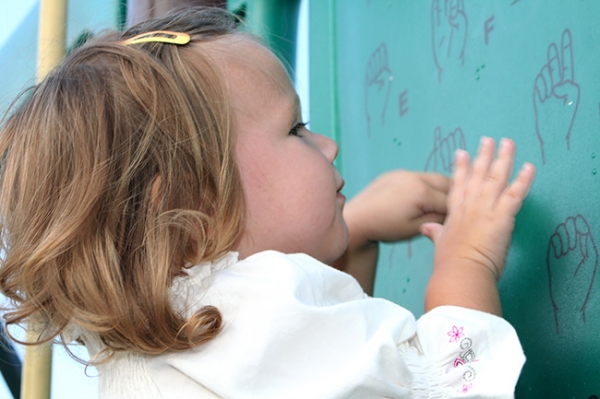
Before I knew it, my sweet, happy, and docile baby transformed into an energetic toddler with a personality all her own. It seemed to happen so suddenly. One day I was holding a cooing infant who only required a full belly, a clean diaper, and her mama’s arms to fall into a state of pure bliss. It was like I blinked and the next thing I knew, I was staring at a toddler. A toddler who was sobbing uncontrollably and flailing her arms with abandon while simultaneously stomping her feet. I had no idea what to do. What did this little person want? Like a lightning bolt, it hit me. My daughter could understand everything I said to her and I understood nothing of what she was trying to communicate to me. She was frustrated. I was frustrated. I knew I had some time before my daughter would be able to dictate her innermost thoughts and desires in complete sentences, so I turned to baby sign language. These baby signs saved my life…and my sanity.

Baby Signs: Please/Thank You/You’re Welcome
When I started researching baby sign language and how it works, the first sign I came across was the sign for “more”. I taught my daughter this sign, but she had trouble picking it up. More…what? She is a toddler. She wants more of everything! Alternatively, I taught her the sign for “please”. I showed her how to point to what it was she wanted and then sign “please” by rubbing her hand over her chest in a circular motion. She picked up this sign in less than a day, as she quickly realized that please really is a magical word. By signing “please” she not only was granted the object of her desire, she began developing confidence. She realized that she was doing something correctly and she was being rewarded, both extrinsically and intrinsically.
- The sign for “please” is done by rubbing your hand over your chest in a circular motion.
- The sign for “thank you” is done by touching your lips like you are blowing a kiss.
- The sign for "you're welcome" is similar to “thank you”, but is done by touching your chin instead of your lips.
I taught my daughter the sign for “thank you” (touching your lips like you are blowing a kiss) in conjunction with “please”. I taught her to sign thank you to me when I provided her with whatever she happened to be asking for, but I also began signing thank you to her each time she exhibited behaviors I deemed as positive, for instance: petting our dog gently, cleaning up her toys, or bestowing a sweet kiss upon my cheek.
My daughter began associating the sign of “thank you” with both objects and acts in which she was grateful for. I receive a “thank you” when I fill her sippy cup with water, but she also signs “thank you” after every story I read to her. The sign for “you’re welcome” (similar to “thank you”, but touching your chin instead of your lips) naturally came next. Now, we had a succession of signs. “Please” fill my sippy cup, “thank you” for filling my sippy cup, followed by my response of “you’re welcome”. We were communicating!
Baby Sign: Hurt
- The sign for “hurt” is done by making two fists, then extending your index fingers to touch one another.
I found that when teaching "hurt" it is also important to make a dramatic pained expression with your face. Your toddler will find this absolutely hilarious until they are actually hurt and that is when this sign becomes indispensable. My daughter awoke one night, screaming in pain. I checked her entire body and could not figure out what was causing her such distress. I asked her what hurt and made the sign. Still crying, she mimicked the sign for “hurt” and pointed to her right ear.
Just to be certain, I pointed to her left ear and made the sign for hurt, asking if that ear hurt also. She shook her head and again made the sign for hurt and pointed to her right ear. The pediatrician confirmed it the next morning, she had an ear infection in her right ear. As a parent who constantly frets about all kinds of ailments befalling my child, this is the sign that gives me the most peace of mind.
Related Article: 5 Things Your Toddler Needs You to Know
Baby Signs: Milk vs. Water
Although my daughter has now surpassed the one year milestone and eats a variety of solid food, she still receives a great deal of her calories per day from milk. As the summer months arrived, I noticed that my daughter began nursing more frequently. I realized that she was probably more thirsty than hungry, but unsure of how to ask for water versus milk.
- The sign for "water" is done by making a “W” near your chin with your first three fingers. I demonstrated this by pointing to the water in her cup for reinforcement.
- The sign for "milk" is done by squeezing your fist like you are milking a cow. I demonstrated this sign while pointing to my breast.
Besides teaching my daughter how differentiate between the sensations of hunger and thirst, I have also eliminated the embarrassment of her pulling down my shirt and subsequently flashing strangers in public. Instead of exposing myself to unsuspecting bystanders, if my daughter wants to nurse she signs, “milk” and “please” and we retire to a suitable location.
Baby Sign: Hot and Cold
The signs of “hot” and “cold” may not appear to be life changing on the surface, but I have found great success with these signs.
- We sign “hot” as if we are fanning ourselves from heat. (This is not the real sign, but developed out of actually fanning ourselves from the desert heat in Las Vegas, so it works for us!)
- We make the sign for "cold" by holding our arms close to our bodies and shivering like we are freezing.
These two signs have allowed us to explore our environment, while simultaneously learning about safety. I taught my daughter the sign for “hot” by allowing her to feel the steam for a bowl of hot pasta at a safe distance and the sign for “cold” my rubbing ice cubes in the palm of her hand. I explained that the stove is too hot touch by making the sign for “hot” and then the sign for “hurt”.
I learned that my daughter has very specific preferences for temperature. I had been following the rule listed in every baby book for dressing her, “Dress your child in one layer more than you would wear.” I tend to experience temperature in various stages of near hypothermia, whereas my daughter is apparently a tiny, human space heater.
Now, she tells me if her pajamas or jeans are “too hot”. She also prefers her water with copious amounts of ice to soothe her “hurt” mouth during teething. My favorite is when she takes her cup of crushed ice and makes the “hot” sign and then bursts into laughter before making the “cold” sign. A joke! Toddler stand-up comedy with sign language!
Baby Sign: Help
I love this age of toddlerhood, I really do. My daughter is still one part baby and relies on me for most things: food, clothing, comfort, and of course, positive reinforcement. Even when she is investigating some new treasure, she looks to me for validation. She is also one part independent spirit, with her own likes and dislikes, thoughts and feelings, and perception of the world. Sometimes she needs my help, sometimes she wants my help, and sometimes she just wants to figure things out all by herself.
It is natural to want to jump in and help when I see my daughter is frustrated, but I also want her to develop appropriate problem solving skills.
- The sign for “help” is made by placing one hand palm side up and the other hand in a “thumbs up” position. Then, you use the palm up hand to lift the other hand, as if you are giving a “helping hand”.
- You can extend this motion towards your child to ask if he or she needs your help or reverse it to ask your child to help you.
Sometimes she accepts my help when I offer, but she always leaps at the opportunity to help me. In this way, she is learning how to problem solve independently when able, but recognizes that she may also ask for assistance to avoid frustration. She is also learning the importance of helping others and developing a sense of self-worth.
My daughter and I like to add several new signs to our repertoire each week and can actually engage in conversation! I say each word aloud simultaneously, in order to develop and reinforce her oral vocabulary. The frustration for my toddler is gone, as if I have removed her from the foreign immersion program that she never signed up for. My sanity has remained intact because I know that I can effectively meet my daughter’s needs while also fostering her independence. “Thank you” baby sign language!
For more on baby sign language visit www.signbabies.com.